ICU Nursing Interview Questions: What to Expect and How to Prepare

ICU interviews are different.
On a med-surg floor, a hiring manager wants to know that you can manage a high patient load, stay organized, and communicate clearly. Those things matter in the ICU too. But in critical care, the bar shifts. The manager is trying to answer one specific question: does this person think safely when things go wrong fast?
Every question in an ICU interview — even the soft ones — is probing for that.
"Tell me about a time you had to make a quick decision" isn't really about decision-making. It's about whether you froze or stayed systematic. "How do you prioritize two critical patients?" isn't a trick question. It's checking whether your clinical reasoning has a structure, or whether you'd just react based on gut instinct.
This guide covers the ICU interview questions that come up most often, why they're being asked, and what a strong answer actually sounds like. There's also a section for new grads and specialty switchers — because those interviews look a little different, and the preparation needs to match.
How ICU Interviews Are Different From Other Nursing Interviews
Before getting into specific questions, it helps to understand the mindset of the person across the table from you.
An ICU nurse manager has usually spent years in critical care. They've seen what happens when a nurse panics during a rapid deterioration, calls for help too late, or doesn't recognize a clinical red flag that should have been obvious. Their job is to protect patients — and that means they will not hire someone who gives vague answers to clinical questions.
In most nursing interviews, you can recover from a weak clinical answer with strong behavioral examples. In an ICU interview, that's harder. If you describe a clinical scenario and your approach doesn't include a structured assessment — airway, breathing, circulation first — the manager will notice. If you say you'd call the attending before stabilizing the patient, that's a problem.
You don't need to have worked in an ICU to interview for one. But you do need to show that you understand how critical care nurses think. That means being familiar with the ABCDE assessment framework, knowing when and how to use SBAR for escalation, and being able to talk through deterioration scenarios in a way that sounds organized, not panicked.
The rest of this guide is built around that.
The ABCDE Framework — Know It Cold
If there's one thing to internalize before an ICU interview, it's this.
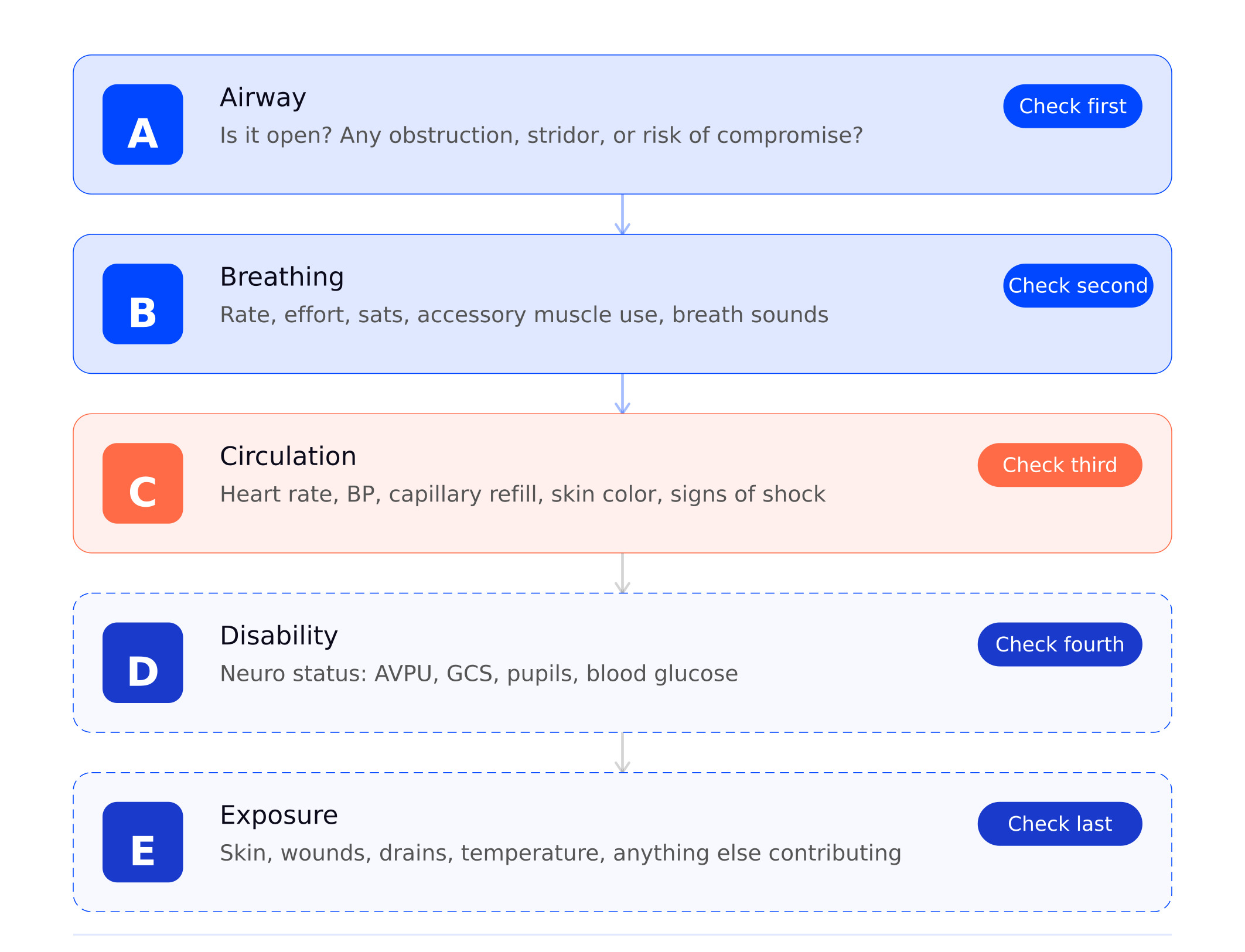
ABCDE stands for: Airway, Breathing, Circulation, Disability, Exposure.
It's the structured order for assessing a critically ill or rapidly deteriorating patient. The logic is simple: each step addresses the most immediately life-threatening problem before moving to the next. You don't worry about a patient's neurological status (Disability) if their airway isn't open.
In an ICU interview, any question involving patient deterioration, a clinical emergency, or a complex scenario is an opportunity to demonstrate this framework. You don't need to say "I'm using ABCDE" out loud. You just need to walk through your thinking in that order.
Here's what each step covers:
- Airway — Is it patent? Is there a risk it won't stay that way? Does anything need to happen right now to protect it?
- Breathing — What is the respiratory rate, oxygen saturation, effort? Are there accessory muscles being used? Is the patient protecting their airway but not ventilating well?
- Circulation — What's the heart rate, blood pressure, capillary refill? Are there signs of hemorrhage, sepsis, or shock?
- Disability — What is the neurological status? AVPU scale (Alert, Voice, Pain, Unresponsive), pupils, Glasgow Coma Scale, blood glucose.
- Exposure — What else might be contributing? Any rashes, wounds, drains, lines, external bleeding, temperature abnormalities?
If an interviewer asks "walk me through how you assess a patient who seems off," your answer should move through these five steps in order. That structure signals to any critical care nurse that you've trained yourself to think systematically — not reactively.
The Most Common ICU Interview Questions
"Walk me through how you would respond to a patient going into respiratory failure."
This is the most common clinical scenario question in ICU interviews. It's designed to see whether you stay calm, whether you follow a structured approach, and whether you know when to call for backup.
"The first thing I'm doing is getting to the bedside and starting my assessment — airway first. Is the airway patent? Is the patient making any effort to breathe? From there, breathing: what's the respiratory rate, what are the sats, is the patient using accessory muscles? I'm putting them on supplemental oxygen while I'm doing this — highest available if things look bad.
Then circulation: heart rate, blood pressure, any signs that this is a cardiac problem and not a pure respiratory one.
I'm calling for help early. In a true respiratory failure situation, I'm not managing it alone — I'm activating the team. While I'm calling, I want someone at the bedside. I'll give a quick SBAR to whoever I reach: what I'm seeing, the patient's relevant background, my assessment, and what I'm asking for — usually the physician and respiratory therapy at the bedside now.
If the patient is intubated and I have a vent alarm going, I'm using the DOPE mnemonic to troubleshoot: Displacement, Obstruction, Pneumothorax, Equipment failure. I'm bagging manually if needed until I've identified the problem."
Why this works: It's structured. It shows ABCDE thinking without announcing it. It calls for help at the right time — early, not as a last resort. And the DOPE mnemonic at the end shows familiarity with ventilated patients specifically, which matters in the ICU.
"Tell me about a time a patient deteriorated unexpectedly. What did you do?"
This question shows up in almost every ICU interview. They're not looking for a dramatic story. They're looking for how you organize your thinking when the situation shifts.
"During my ICU rotation, I had a post-op abdominal surgery patient who had been stable through most of the shift. Around hour five, he told me he felt off — just tired, a little short of breath. His vitals looked okay at first glance, but his respiratory rate had gone from 16 to 22, and his oxygen sat had drifted down about three points from his baseline.
I did a quick assessment at the bedside — airway was fine, but he was definitely working harder to breathe. I checked his abdomen and he seemed to be guarding more than earlier. I called the physician using SBAR: he was a post-op day one patient, relevant history was his surgery and the anticoagulation he was on, my assessment was that something had changed clinically and I was concerned about bleeding, and I was asking for a bedside evaluation now.
The attending came and ordered imaging. He had an internal bleed that needed to go back to the OR. He went within about 90 minutes of my call.
What I took from that: a patient saying 'I feel off' is a clinical data point. I don't dismiss it just because the vital signs aren't alarming yet."
Why this works: The answer is honest and specific. It doesn't claim a dramatic save — it shows careful observation and early escalation. The lesson at the end is concrete and memorable, not a generic "I'll always trust my instincts."
"How do you prioritize when two critical patients both need you at the same time?"
This is a judgment question, not a trick question. There's no single right answer — what they want to see is that you have a process.
Key points to hit:
- Start with the most time-sensitive, life-threatening need. Someone in respiratory distress comes before someone who needs a dressing change, even if both are "critical care" patients.
- Make sure someone is physically present with the patient you can't get to immediately. Call for backup or ask your charge nurse — don't leave a patient alone in an unstable state.
- Communicate. Tell the second patient what's happening if they're conscious. Document the time you responded to both.
- Know when to ask for help and do it without hesitation.
What NOT to say: "I'd just try to do both as fast as possible." This answer tells the manager nothing about your clinical reasoning, and it implies you'd rush rather than prioritize.
"Tell me about a clinical mistake you made and what you learned from it."
This question is more pointed in an ICU interview than in a general behavioral round. They're asking about a clinical error — something that directly affected a patient's care — not a communication failure or a documentation mix-up.
Read our full breakdown of this question in 50 Nursing Interview Questions and Answers, where we cover the clinical version in detail. The short version: answer honestly, show that you identified what you missed clinically, and describe the specific habit or practice you changed as a result.
The one thing to avoid: Answering with "I can't think of one" or minimizing the error by blaming the situation. ICU managers have seen the consequences of nurses who don't acknowledge their mistakes. Accountability is the whole point.
"What's your experience with vasoactive drips and ventilator management?"
If you've worked in the ICU, be specific about which drips you've managed and in what context. If your experience is limited to rotations or simulation, say so directly — and show that you used that time to learn.
"During my ICU rotation I didn't independently manage vasoactive drips, but I spent time with the staff nurses and the pharmacist understanding how vasopressors work — specifically norepinephrine and vasopressin. I wanted to understand the mechanism, the titration parameters, and what to watch for clinically, not just how to hang the bag. With ventilators, I'm comfortable with basic modes — AC and SIMV — and I understand the concepts behind lung-protective ventilation. I've been studying AACN critical care materials since I started looking for ICU positions, specifically to close that gap."
Why this works: It's honest about what the candidate hasn't done yet. But it shows initiative — reaching out to the pharmacist, studying outside of work — which is exactly what a new grad who will succeed in the ICU actually does.
"Have you ever disagreed with a physician about a patient's care? What happened?"
This is one of the most commonly asked questions in all RN interviews, and it carries extra weight in the ICU where you're working directly alongside attendings and residents every shift.
See the full model answer in 50 Nursing Interview Questions and Answers. The key is to show that you raised the concern with specific clinical data — not just a feeling — and that you went through the right channel. In the ICU, that usually means calling the attending directly, escalating to the fellow or charge nurse if needed, and documenting everything.
The one answer that fails every time: "I would just follow the doctor's orders." It tells the hiring manager you won't advocate for your patients. No ICU manager wants to hire someone who will not push back when something doesn't look right.
"How do you manage a high-acuity assignment when both patients are complex?"
ICU nurses typically manage one to two patients, but those patients are often critically ill with multiple active problems. This question is about your organizational approach, not your stamina.
Key points to hit:
- Talk through how you do your initial assessment at the start of the shift — going through each patient systematically before the day gets busy.
- Explain how you prioritize time-sensitive medications, drip titrations, and assessments.
- Mention communication: keeping your charge nurse updated when things shift, looping in the team proactively.
- Show that you know the difference between what needs to happen right now and what can wait 20 minutes.
Questions for New Grads Entering the ICU
Getting your first job in the ICU as a new grad is harder than it used to be, but it still happens — especially at hospitals with structured residency programs designed for this transition. If you're interviewing for a new grad ICU position, your interview will look a little different.
The hiring manager knows you haven't managed a vented patient independently. They're not testing clinical experience you can't have yet. They're testing three things: your clinical reasoning, your self-awareness, and whether you're the kind of person who will ask for help before you're in over your head.

Questions you're likely to get:
- "Why the ICU as a new grad — why not start on med-surg first?"
- "What do you feel least prepared for in critical care?"
- "Tell me about a clinical situation from your rotations that pushed you."
- "How do you handle not knowing something in the middle of a busy shift?"
- "What would you do if your preceptor gave you feedback you disagreed with?"
How to approach "Why the ICU as a new grad?"
This question has a trap built into it. If you answer "because I love the challenge," that sounds immature. If you answer "because I've always been interested in critical care," that's too vague.
The strongest answer connects your clinical experience — rotations, simulation, patient care tech work — to a specific kind of nursing thinking that you already lean toward. Something like: "During my ICU rotation, I noticed that the nurses who seemed most at ease were the ones who thought in a really systematic way — they were always one step ahead of the monitor. That's how I want to practice. I want to build those habits at the beginning of my career, not try to learn them later."
How to approach "What do you feel least prepared for?"
Be specific and be honest. "I know managing a full assignment of two vented patients is going to be a steep learning curve" is stronger than "I feel pretty prepared for most things." Follow it with how you're preparing: studying critical care content, getting your ACLS, asking to shadow nurses during your rotation.
Questions for Specialty Switchers Entering the ICU
If you're coming from med-surg, the ED, a step-down unit, or any other specialty, you bring real clinical experience. The challenge in an ICU interview is showing that you can translate it — and that you understand the differences between where you've been and where you're going.
Questions you're likely to get:
- "You've been on a med-surg floor for three years — why the ICU now?"
- "What's the biggest difference between how you've practiced and how you'll need to practice here?"
- "Tell me about a time you managed an unstable patient on your current unit."
- "What steps have you taken to prepare for this transition?"
What interviewers are watching for:
They want to see that you're not underestimating the shift. A nurse who says "I've seen a lot on med-surg, I think I'm ready for anything" sounds overconfident. A nurse who says "I know the pace and acuity are different here, and I've been intentional about preparing for that" sounds like someone who will actually succeed.
Talk about what you've done to close the gap: ACLS or CCRN preparation, time spent in the ICU during float shifts, self-directed learning on ventilator management, conversations with ICU nurses you know.
What to Ask the ICU Hiring Manager
The questions you ask at the end of the interview matter. See our full guide on questions to ask in a nursing interview for a complete breakdown. For ICU-specific questions, the strongest ones are:
- "What does the nurse-to-patient ratio look like here, and does it change for patients on continuous drips or immediately post-surgery?"
- "How does the unit handle proning patients — is it a team protocol or does the bedside nurse coordinate it?"
- "What does onboarding look like for nurses coming from a different specialty — how long is orientation and is there a consistent preceptor throughout?"
- "What's the biggest clinical challenge nurses face on this specific unit right now?"
These questions show you've thought about what ICU nursing actually involves — not just that you want the job.
The Bottom Line
ICU interviews test clinical reasoning more than any other nursing interview format. The hiring manager is trying to find out whether you think in a structured, safe way when things get complicated — not whether you have the perfect answer to every question.
Go in knowing ABCDE cold. Know how to use SBAR to escalate. Be ready to talk through a deterioration scenario in a systematic way. And be honest about your experience level — whether that's a new grad who has done their homework, or an experienced nurse making a deliberate transition.
The nurses who stand out in ICU interviews are not the ones who claim to be ready for everything. They're the ones who can show they know how to think.
Practice ICU interview questions before the real thing.
Vorna generates role-specific interview questions based on your resume and the ICU job you're applying for — then gives you a full feedback report on your answers, including ABCDE and SBAR framework scoring. Free to start.
Looking for a broader set of nursing interview questions? Read 50 Nursing Interview Questions and Answers →